Are Video Games Actually Bad for Kids? What the Research Really Says with Dr. Rachel Kowert & Arana Shapiro
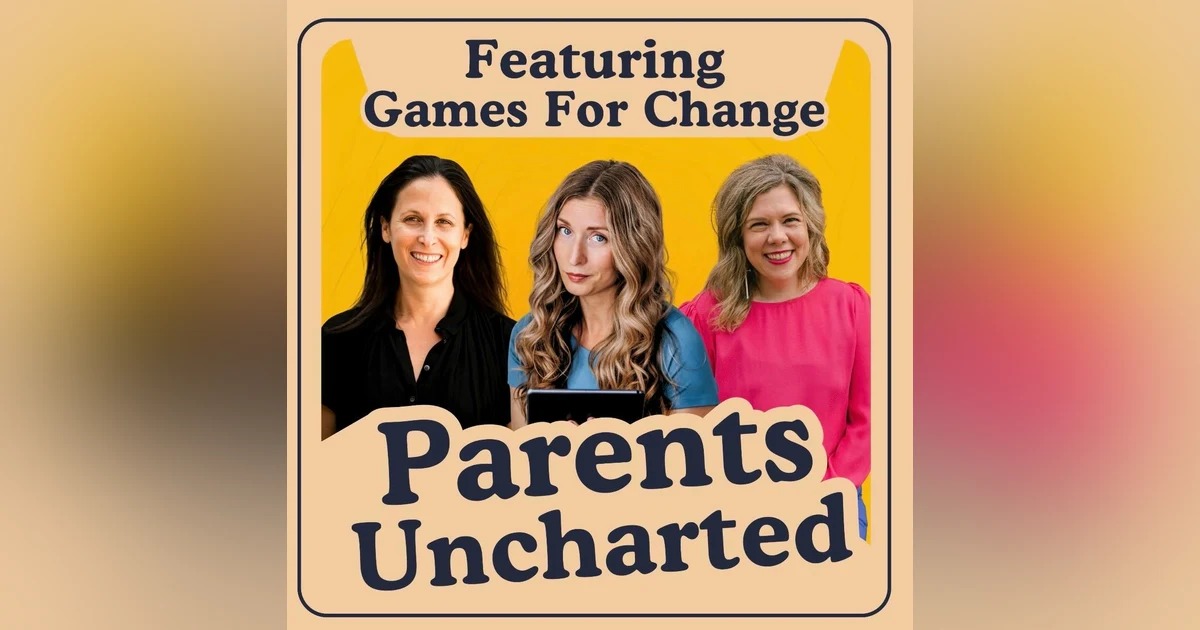


Video games are often treated as one more screen to limit, a source of family conflict or a threat to children’s well-being. But what if parents are asking the wrong questions about gaming?
In this episode of Parents Uncharted, Sarah speaks with Dr. Rachel Kowert and Arana Shapiro from Games for Change about how families can approach video games with less fear, more curiosity and better information.
Their new white paper, Raising Good Gamers: What Families Need to Know About Video Games and Wellbeing, found that parents looking online for gaming advice are five times more likely to encounter negative messaging than practical, evidence-based guidance, even though nearly 60% of children say they want their parents involved in their gaming experiences.
Together, Sarah, Rachel and Arana examine why all screen time should not be treated equally, what children may be learning through play and how parents can distinguish enthusiastic gaming from genuinely problematic behaviour. They also discuss violent video games, online friendships, Roblox safety, collaborative boundaries and the often-overlooked social, cognitive and emotional benefits of gaming.
In this episode, we discuss:
Why gaming is fundamentally different from passive screen use
The disconnect between gaming research and the advice parents encounter online
What games like Animal Crossing can teach children about reading, math, resource management and problem-solving
How to recognize when gaming is beginning to interfere with sleep, relationships or basic needs
What decades of research say about violent video games and violent behaviour
Why the quality and context of gaming matter more than an arbitrary number of minutes
How games can build cooperation, communication, conflict-resolution skills, identity and resilience
Why online friendships can be meaningful sources of social and emotional support
How parents who do not enjoy gaming can still show interest in their child’s digital life
How to set limits without turning gaming into a constant power struggle
What parents should know about safety concerns on Roblox
The SPACE framework for healthier family gaming
This conversation is not an argument for unlimited gaming or for ignoring legitimate platform risks. It is an invitation to move beyond blanket fear and become more informed, curious and involved in the spaces our children value.
Because raising healthy gamers does not begin with controlling every minute. It begins with understanding what our children are doing, creating boundaries with them and staying close enough that they continue talking to us.
Chapters
(00:00) Introduction
(01:40) What is Games for Change?
(04:50) Why parents are still asking the same gaming questions
(06:39) The biggest misconceptions about video games
(08:20) What children can learn from Animal Crossing
(11:13) Healthy gaming versus problematic gaming
(15:04) Do violent video games cause violent behaviour?
(17:23) Why quality matters more than quantity
(20:53) The social, emotional and cognitive benefits of gaming
(23:42) How video games help children practise resilience
(24:04) Creating boundaries without constant conflict
(27:30) How non-gaming parents can connect with their children
(28:54) Online friendships, autonomy and safety
(33:38) The SPACE framework for healthy gaming
(35:16) When parents or co-parents have different gaming rules
(37:03) How parents should approach Roblox
(40:10) What every parent should remember about gaming
(41:06) Where to find Games for Change and Raising Good Gamers
About the Guests:
Dr. Rachel Kowert
Dr. Rachel Kowert is a research psychologist, award-winning author and the research director at Games for Change. For more than 15 years, her work has focused on mental health, online safety, trust and social connection within digital games.
She has presented her research to organizations including the United States Congress, the United Nations and the Department of Homeland Security. Her work helps translate academic research about games and digital communities into practical guidance for families, educators and policymakers.
Arana Shapiro
Arana Shapiro is the chief operating and programs officer at Games for Change. She is an educator and social entrepreneur with more than 20 years of experience using games, play and game design to transform learning.
Arana previously helped develop Quest to Learn, the first public school built around a game-based learning model. Her work focuses on helping young people, educators and families use games as tools for learning, creativity, citizenship and positive social impact.
About Games for Change
Games for Change is a nonprofit organization that works to demonstrate how games and immersive media can create social impact beyond entertainment.
Its work brings together game developers, researchers, educators, policymakers and young people through initiatives including the annual Games for Change Festival, youth and educator programs, and Raising Good Gamers, an initiative designed to help families better understand video games and build healthier gaming environments.
Resources and Where to Connect:
Games for Change: gamesforchange.org
Raising Good Gamers: raisinggoodgamers.org
White paper: Raising Good Gamers: What Families Need to Know About Video Games and Wellbeing
Connect with Sarah Adams:
https://momuncharted.com/
https://www.instagram.com/mom.uncharted/
https://www.tiktok.com/@mom.uncharted
http://parentsuncharted.com/
https://www.instagram.com/parents.uncharted/
https://www.tiktok.com/@parents.uncharted
Learn more about your ad choices. Visit megaphone.fm/adchoices